Sources rayonnantes
for ensemble and electronics
2023
Premiered 17 June 2023
Espace de projection, Ircam, Paris
Sources rayonnantes (Radiant Sources) is a piece conceived, developed and composed from the notions of physical space and virtual space. The placement of the instruments in the concert hall, here Ircam’s Espace de projection, is the starting point for the journey and radiation of sounds through space. Both the instrumental and the electronic parts are thus written in direct relation to this space, in a kind of “orchestration of space”: the immersive electronics and the hall’s ambisonic sound system enlarge and burst open the sonic space.
The two parts were conceived as a single score. They are interdependent and cannot exist separately, since the sonic and musical result of the piece emerges from their superimposition. The electronics can act as a timbral and spatial extension of the instruments, taking them beyond their own limits, but they can also generate musical structures. Although some of the electronic material comes from instrumental sounds, the electronics have a development and articulation equivalent to, and often more elaborate than, the instrumental part, thanks to the use of different kinds of processes. Among other things, they make sound travel and create sound masses in space through granular and concatenative synthesis, or through spatial synthesis (synthesis driven directly by the position of the sound in space). They also produce extreme rhythmic accelerations that can, for example, turn a rhythm into a pitch, a device used recurrently throughout the piece.
The detailed writing of the electronics, realised entirely in real time, was made possible by the AntesCollider library, a dynamic system for synthesis, processing and analysis that combines Antescofo, the synchronous programming language developed at Ircam by Jean-Louis Giavitto, with the SuperCollider audio synthesis engine.
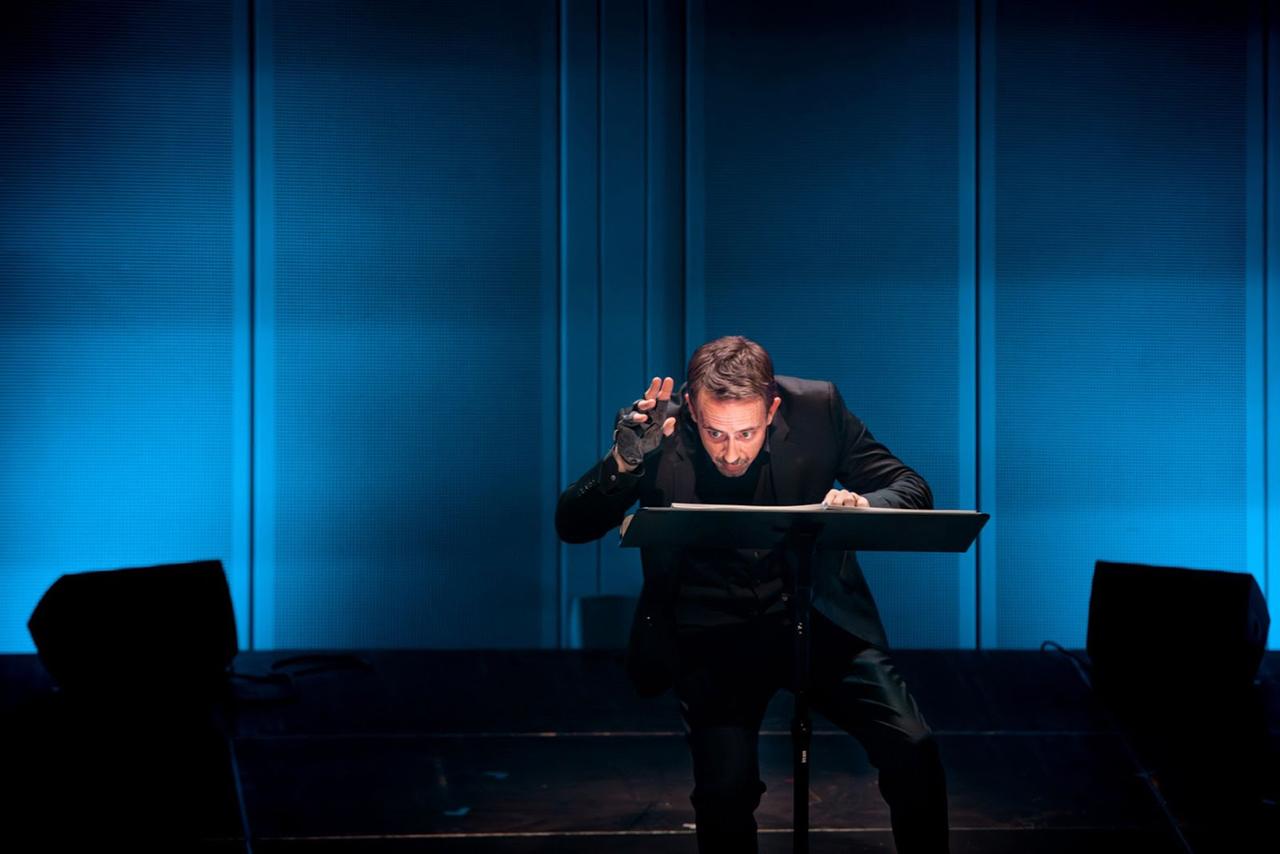
Synchronisation between the instrumental and electronic parts relies on a gesture-following system: Gesture Follower, developed by Ircam’s Sound Music Movement Interaction team (ISMM) and implemented by Serge Lemouton. Based on machine learning, this system lets the computer follow the conductor’s gestures by analysing data from a sensor (a 9-axis R-IoT sensor measuring 3D movement) and comparing it with a recording of gestures made beforehand by the same conductor. This technique makes it possible not only to know where the conductor is in the score, but also to infer the tempo of the beat as the piece unfolds. The conductor’s tempo is then used directly by the Antescofo timing language to set the speed of the electronic events, which, being generated in real time, adapt to musical time like any other section of the orchestra.
Despite these considerations about how it was written, the piece unfolds in a rather intuitive way. The sound itself guides the musical discourse, and no compositional system or concept is imposed beforehand. In my view, this gives sound the freedom to move from one place to another, spontaneously and without constraint.
Sources rayonnantes is a tribute to the Indigenous peoples of South America, to their ancestral traditions, their cosmologies and their relationship to the environment; and to the medicine men and women who, for thousands of years, healed the members of their tribes with their songs and music, their visions and their belief in the spirit world. The piece offers something like an imaginary journey into this mysterious, unknown world.